
Sun Mechanics
Why the sun moves the way it does — Earth's rotation, its tilted axis, and the three small facts of astronomy that everything in sundial design is built on.
The sun appears to move. It doesn't — the Earth does. But from the ground, with a stick in front of you, the distinction doesn't matter. What matters is that the sun's apparent motion is almost perfectly regular, and the small ways in which it isn't regular are the reason sundial design became a real branch of mathematics rather than a craft of rough approximations.
Three facts of astronomy underlie every sundial on every wall. This article is a tour of those three facts and their consequences.
Fact one: the Earth rotates
The Earth completes one rotation on its axis in about twenty-four hours. Not exactly — a solar day averages 24 hours 0 minutes 0 seconds, but a sidereal day (one rotation relative to the stars) is 23 hours 56 minutes 4 seconds. The four-minute difference is the Earth moving along its orbit, so it has to turn slightly further each day to bring the sun back to the same position in the sky. The rotation itself is remarkably uniform: the Earth doesn't speed up or slow down perceptibly within human timescales.
From this single fact comes the sundial's most fundamental number: 15 degrees per hour. The sun's apparent motion across the sky is 360° ÷ 24 h = 15°/h. Every hour line on every properly-built sundial depends on this rate.
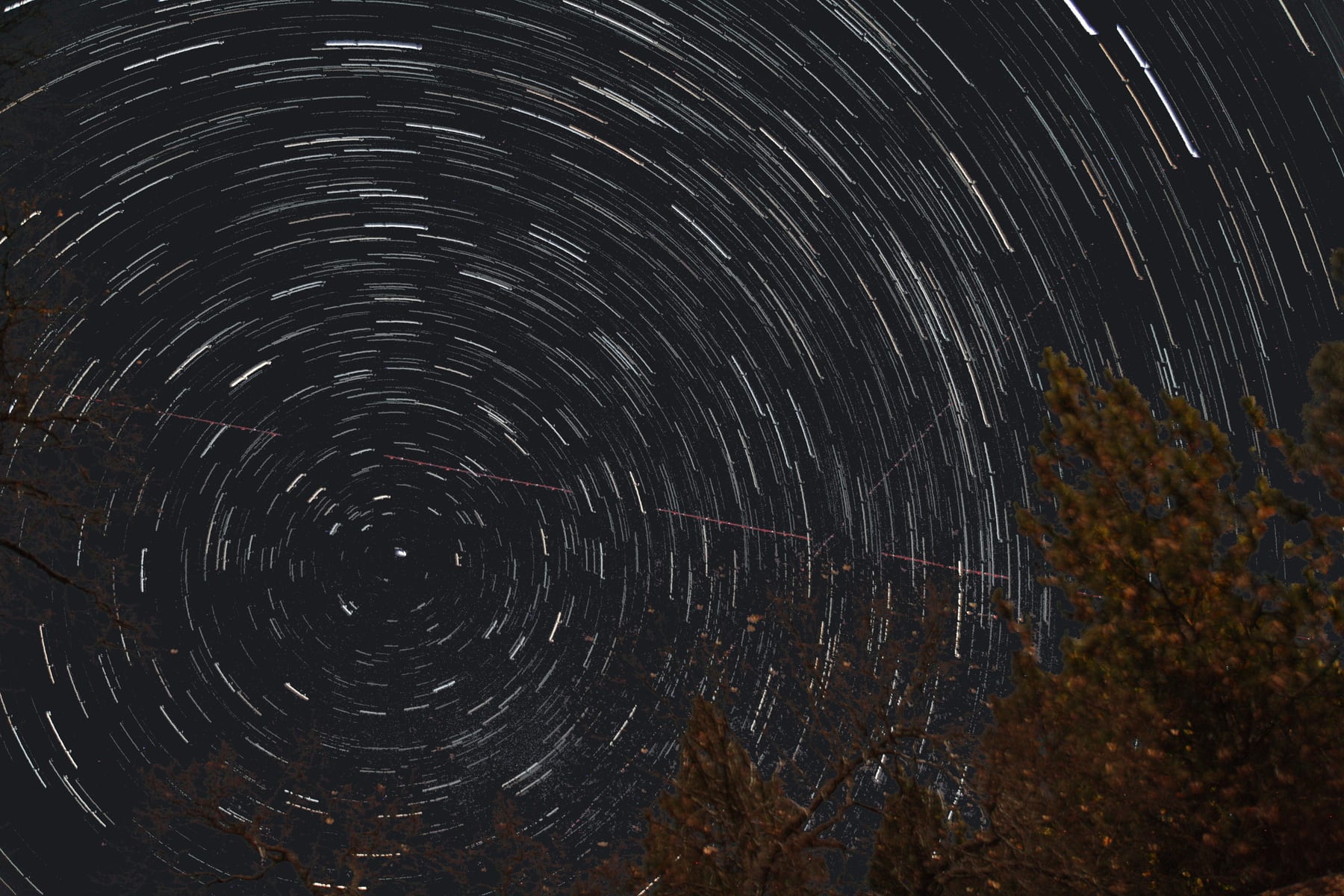
The gnomon of a sundial points at that same celestial pole. The shadow it casts rotates around the dial at exactly the same 15°/h the stars above move at, because both are consequences of the same rotation.
Fact two: the Earth's axis is tilted
The axis the Earth rotates on is not perpendicular to the plane of its orbit around the sun. It is tilted by 23.44° — a figure known to astronomers as the obliquity of the ecliptic. This tilt is what produces seasons, day-length variation, and the figure-eight analemma traced by the sun over a year.
The value has been known to within a fraction of a degree since antiquity. Eratosthenes of Cyrene, working at the library of Alexandria around 220 BCE, measured it at approximately 23°51'. Hipparchus of Rhodes (c. 150 BCE) refined the figure. In the 9th century CE, the astronomer Al-Battani at al-Raqqa on the Euphrates obtained 23°35', within two minutes of arc of the modern value. These were not trivial measurements: Eratosthenes compared the length of a gnomon's noon shadow at Alexandria with a separately-timed observation at Syene (modern Aswan, on the Tropic of Cancer), where the sun is directly overhead at summer solstice.
Long-term variation. The tilt is not quite constant. Over a cycle of roughly 41,000 years it oscillates between 22.1° and 24.5° — an effect named after the Serbian astronomer Milutin Milanković, who worked out the cycle's role in ice ages in the 1920s. At present the tilt is decreasing by about 47 arc-seconds per century. For sundial purposes, this is imperceptible; over a human lifetime the change is around 30 arc-seconds, less than the angular width of a hair at arm's length.
Fact three: the sun's declination varies
Because of the tilt, the sun's declination — its angular height above or below the celestial equator — changes throughout the year. At the summer solstice (around 21 June in the Northern Hemisphere), the sun is as far north as it gets: +23.44°. At the winter solstice (around 22 December), it is −23.44°. At the two equinoxes, declination is 0°. Between these points the curve follows a close approximation of a sinusoid.
Declination controls almost everything about how the sun appears in the sky:
- Day length — from near 24 hours at midsummer above the Arctic Circle to near 0 hours at midwinter, or a gentle 10–14 hour swing at mid-latitudes.
- Solar noon altitude — the maximum height the sun reaches on any given day, equal to 90° − |φ − δ|, where φ is your latitude and δ is the sun's declination.
- The position of sunrise and sunset on the horizon — only due east and due west at the equinoxes; shifted north in summer, south in winter.
What this looks like, at your latitude
The interactive diagram below plots the sun's altitude above the horizon across a full day, for three reference dates: summer solstice, equinox, and winter solstice. Move the latitude slider and watch the three curves change.
A few things to notice:
- At the equator (latitude 0°), the equinox arc reaches exactly 90° — the sun passes directly overhead at noon. The summer and winter arcs are nearly symmetric, both peaking at 66.56°, because the 23.44° tilt moves the sun to either side of vertical by the same amount.
- At mid-latitudes (40–50°) the curves fan out dramatically. Summer days run roughly 15 hours; winter days 9. Peak altitude varies from about 73° in summer to 27° in winter.
- Past 66.56° latitude — the Arctic and Antarctic Circles — the winter arc stops reaching the horizon at all. At latitude 70°, the summer sun doesn't set (midnight sun) and the winter sun doesn't rise.
A vertical sundial at any mid-latitude location must handle this full range. At the summer solstice the wall catches sun from sunrise to late afternoon; at the winter solstice only a narrower band of mid-day hours is illuminated. The calculator on this site works out which hours are illuminated for each season separately, then shows the widest usable window.
Where this meets sundial design
Every sundial problem reduces to these three facts:
-
The gnomon must point at the celestial pole — the point in the sky the stars appear to rotate around — because the sun's apparent motion is relative to that axis. This is why the gnomon's tilt depends on your latitude: the pole's altitude above the horizon equals your latitude.
-
Once the gnomon is parallel to the rotation axis, the shadow sweeps at a uniform 15° per hour around the gnomon. The design task is to project that uniform rotation onto whatever surface the dial face happens to be — flat, vertical, declined, domed — and to mark off the hour lines where the shadow will fall at each clock hour.
-
The fact that declination changes through the year means the shadow will fall in slightly different places across the dial face through the seasons. A well-built sundial handles this by drawing hour lines — not points — that the shadow crosses at the same clock hour regardless of season. (More elaborate dials also show date-lines that the shadow tip sweeps through across the year.)
If you want to see the full geometric story, the next article walks through wall-mounted sundials step by step and shows how style height, substyle distance, and hour-line angle all derive from these three facts applied to the specific wall in front of you.
Further reading: How Vertical Sundials Work · What Is a Sundial? · A History of Sundials