
What Is a Sundial?
The oldest precision instrument still in daily use. How a shadow, a surface, and some geometry tell time — no batteries, no gears, no moving parts.
A sundial tells time using the position of the sun's shadow. That much is obvious. What's less obvious is that a well-built sundial is a precision instrument — one that encodes your latitude, your longitude, and the tilt of the Earth's axis into a few carefully placed lines on a surface.
No batteries. No gears. No maintenance. And if built correctly, it will still be accurate in three hundred years.
Two parts, one principle
Every sundial has two essential components:
The gnomon — the object that casts the shadow. In most sundials this is a triangular fin or a straight rod. The critical requirement is that its shadow-casting edge must be aligned with the Earth's axis of rotation — aimed at the celestial pole. Get this alignment right and the shadow sweeps across the dial face at a steady 15° per hour, matching the Earth's rotation exactly.
The dial face — the surface marked with hour lines. As the shadow moves, it crosses one line after another, each corresponding to a specific hour of the day.
Why 15° per hour? The Earth completes a full 360° rotation in 24 hours. That's 360 ÷ 24 = 15° per hour — the same angular rate that makes time zones roughly 15° of longitude wide.
The geometry connecting these two parts is what makes each sundial unique. The gnomon angle, the spacing of the hour lines, the range of hours displayed — all are computed from the specific location and orientation where the sundial will be installed.
Three families of sundials
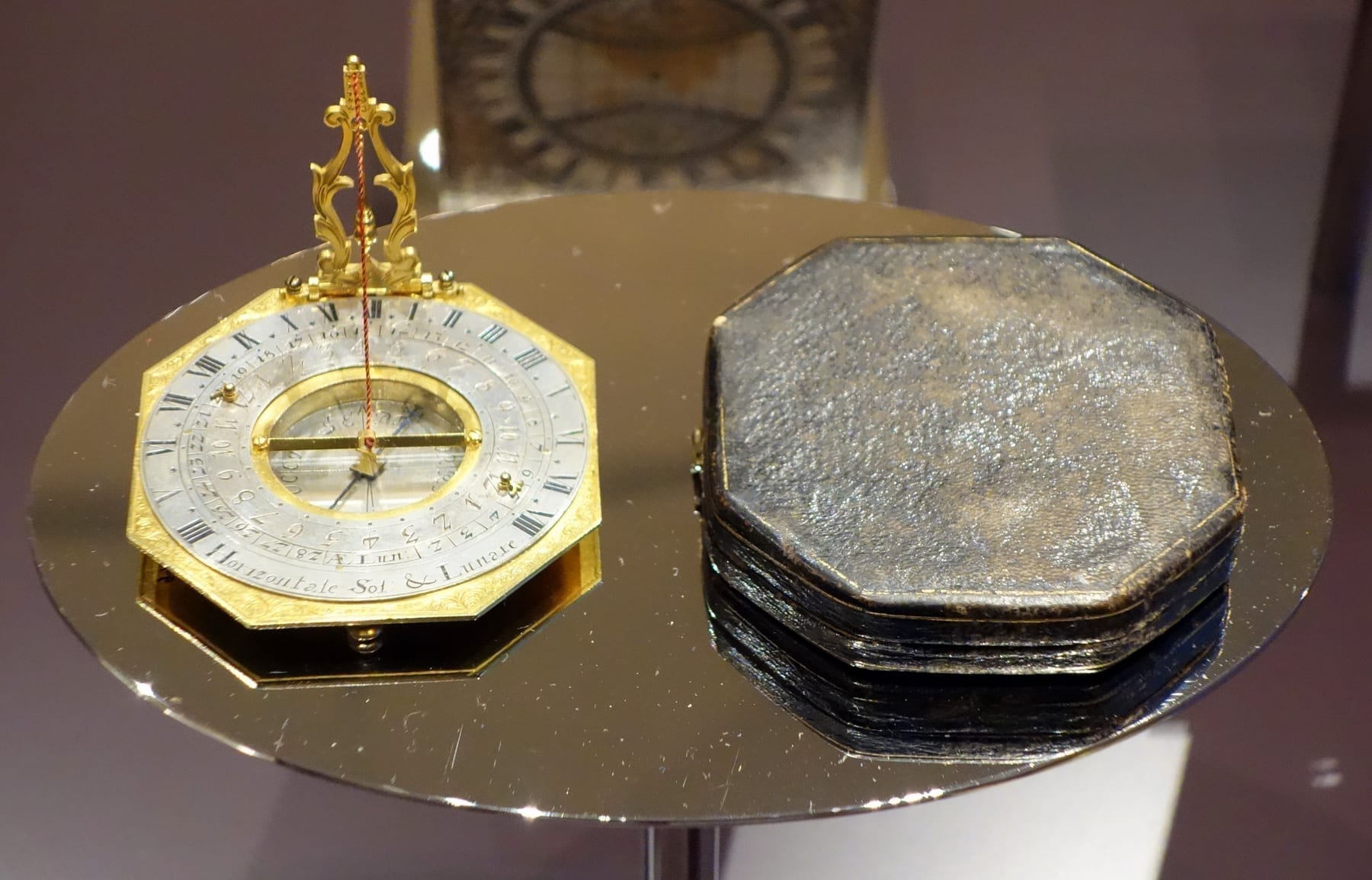
Sundials come in dozens of varieties, but three families cover most of what you'll encounter in the real world.
Horizontal sundials
The classic garden sundial. The dial face lies flat on a pedestal, and the gnomon rises from it at an angle equal to the local latitude. The hour lines radiate outward from the gnomon's base.
Horizontal sundials are forgiving of small errors and straightforward to build, which is why they're the most common type. Most of the decorative sundials sold commercially are horizontal — though many sacrifice accuracy for aesthetics.
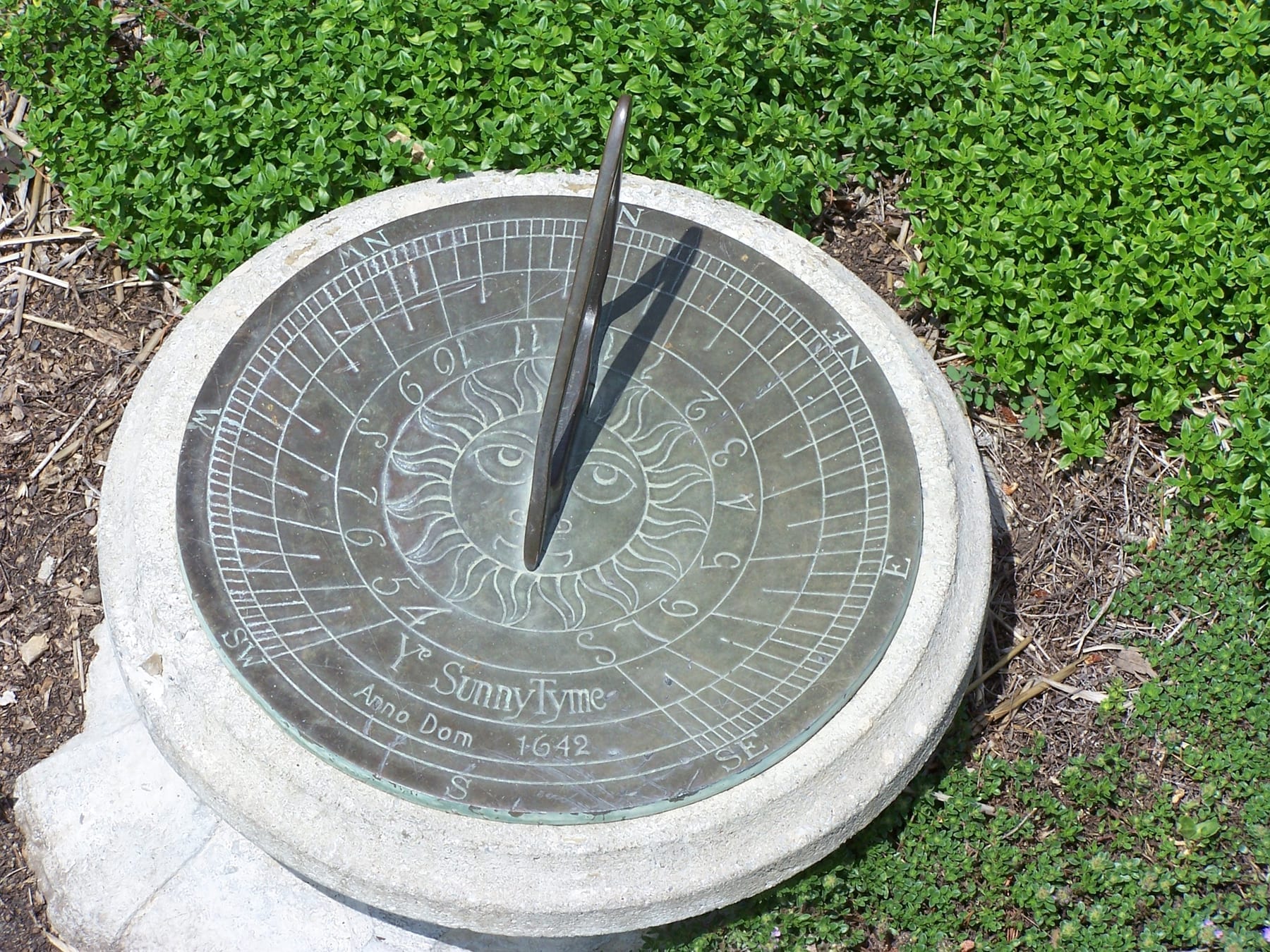
Equatorial sundials
The dial face is tilted to match the plane of the Earth's equator. This makes the geometry almost trivially simple: the hour lines are evenly spaced at exactly 15° apart. The trade-off is that the dial only works from one side at a time — the sun illuminates the upper face in summer and the lower face in winter, switching at the equinoxes.
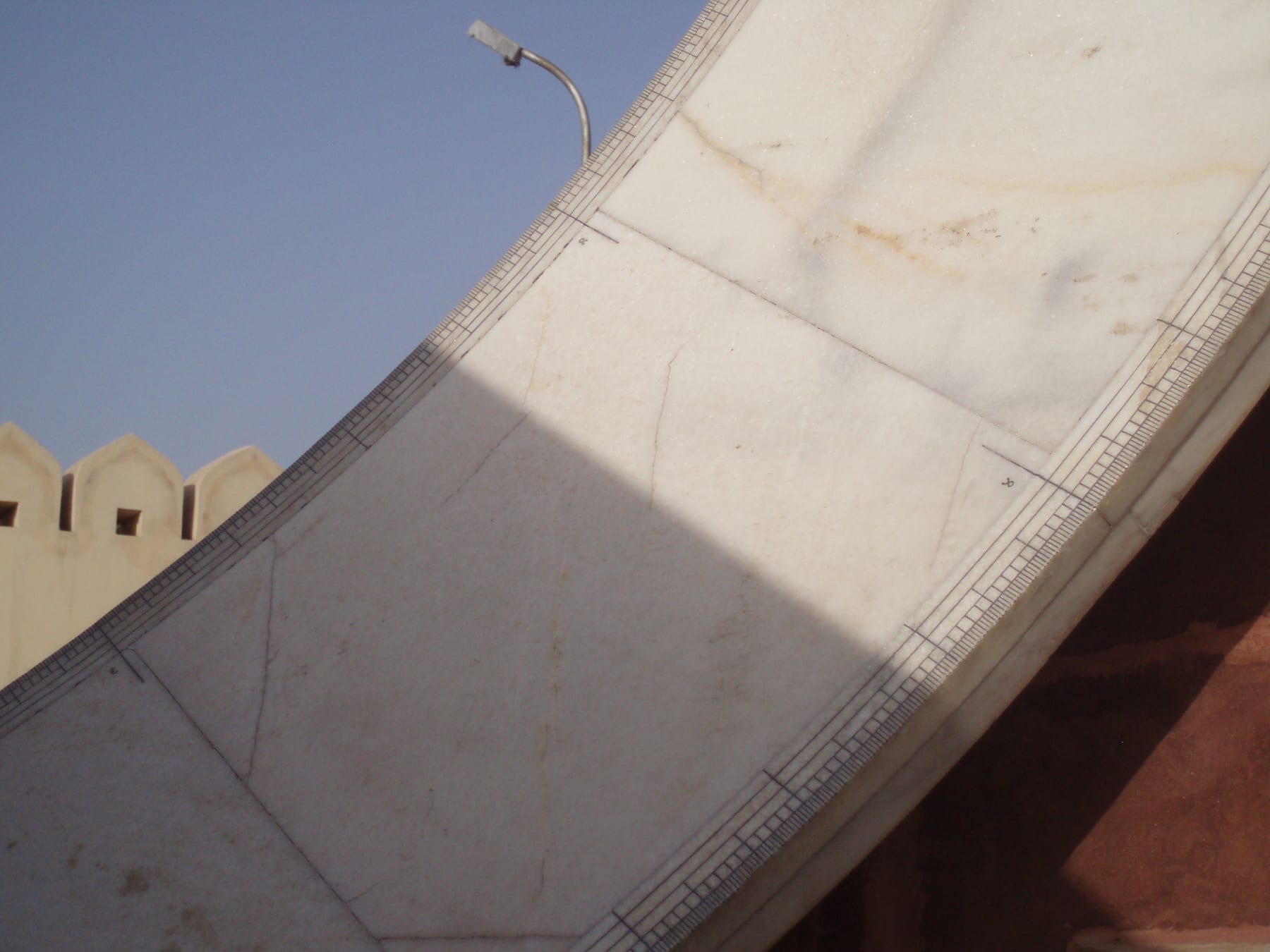
Vertical sundials
Mounted on a wall. These are the sundials you see on the facades of churches, town halls, public buildings, and old houses across Europe and the Mediterranean — but they appear worldwide, on every continent where buildings face the sun.
Vertical sundials are the most mathematically interesting of the three, because the geometry depends not just on latitude but on which direction the wall faces. A south-facing wall produces completely different hour lines than a south-west-facing wall at the same latitude. Every wall gets its own unique dial.
This site focuses on vertical sundials — specifically, vertical declining sundials, meaning sundials on walls that don't face exactly toward the equator. That's nearly every real wall. Learn how the geometry works →
Solar time vs. clock time
A sundial does not show the same time as your phone. It shows local apparent solar time — the time defined by the actual position of the sun in the sky, at your precise longitude, on that specific day.
Your phone shows civil time — a standardised, averaged version of solar time, adjusted for time zones and daylight saving. The two diverge for two reasons:
Longitude correction
Time zones are wide — roughly 15° of longitude — but your phone shows the same time everywhere within a zone. If you're east of the zone's central meridian, solar noon arrives before 12:00 on the clock. If you're west, it arrives after. The offset can reach ±30 minutes depending on where you sit within your time zone.
The Equation of Time
The Earth's orbit is not a perfect circle — it's slightly elliptical. The axis is also tilted at 23.4° relative to the orbital plane. Together, these effects cause the length of a solar day to vary slightly through the year.
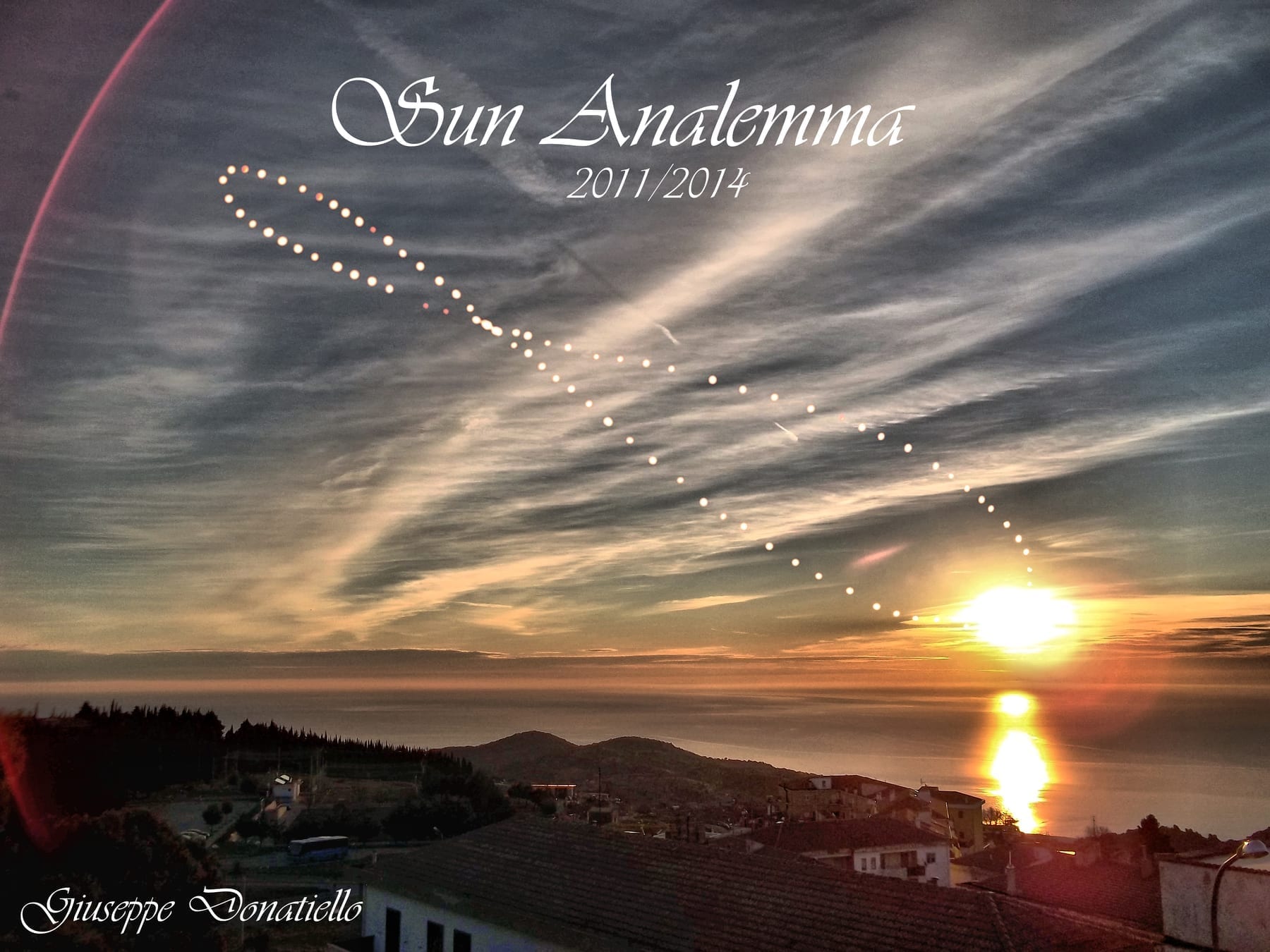
The cumulative result is the Equation of Time: a correction that shifts solar noon by as much as 16 minutes ahead or behind clock noon, depending on the date. In early November, a sundial reads about 16 minutes fast. In mid-February, about 14 minutes slow.
Neither of these is an error. The sundial is reporting where the sun actually is. The clock is reporting a mathematical average. A well-designed sundial often includes a correction table or chart — called an analemma — that lets you convert between the two.
Why build one?
A sundial is one of the few instruments you can design for a specific place and have it remain accurate indefinitely. The mathematics are deterministic: given a latitude, a wall bearing, and a longitude, the correct geometry is fixed. It doesn't drift. It doesn't need recalibration. It doesn't depend on a satellite signal or a battery.
For architects, it's a functional element that responds to the geometry of a building. For educators, it's applied astronomy and trigonometry you can touch. For anyone with a wall that gets a few hours of direct sun, it's a project with a satisfying payoff: an instrument that connects a building to the rotation of the Earth.
The NORTIA SUNDIALS calculator computes the geometry for any wall, at any latitude. Set your location and wall orientation, and the dial face — gnomon angle, hour lines, operating hours — updates in real time.
Next: How Vertical Sundials Work — the geometry behind wall-mounted sundials, explained step by step.