How Vertical Sundials Work
Wall declination, style height, substyle distance — the geometry that makes every wall sundial unique, explained without jargon.
A horizontal sundial — the kind on a garden pedestal — has a relatively simple geometry. The gnomon rises at an angle equal to your latitude, the hour lines radiate from its base, and the math fits on the back of an envelope.
A sundial on a wall is harder. The dial face is vertical, and it almost never faces exactly toward the equator. That misalignment changes everything: the gnomon tilts differently, the hour lines lose their symmetry, and some hours may not appear at all because the sun never illuminates that part of the wall.
This is also what makes vertical sundials interesting. Every wall produces its own unique geometry — and getting it right is the difference between a decoration and an instrument.
Step 1: Find the wall declination
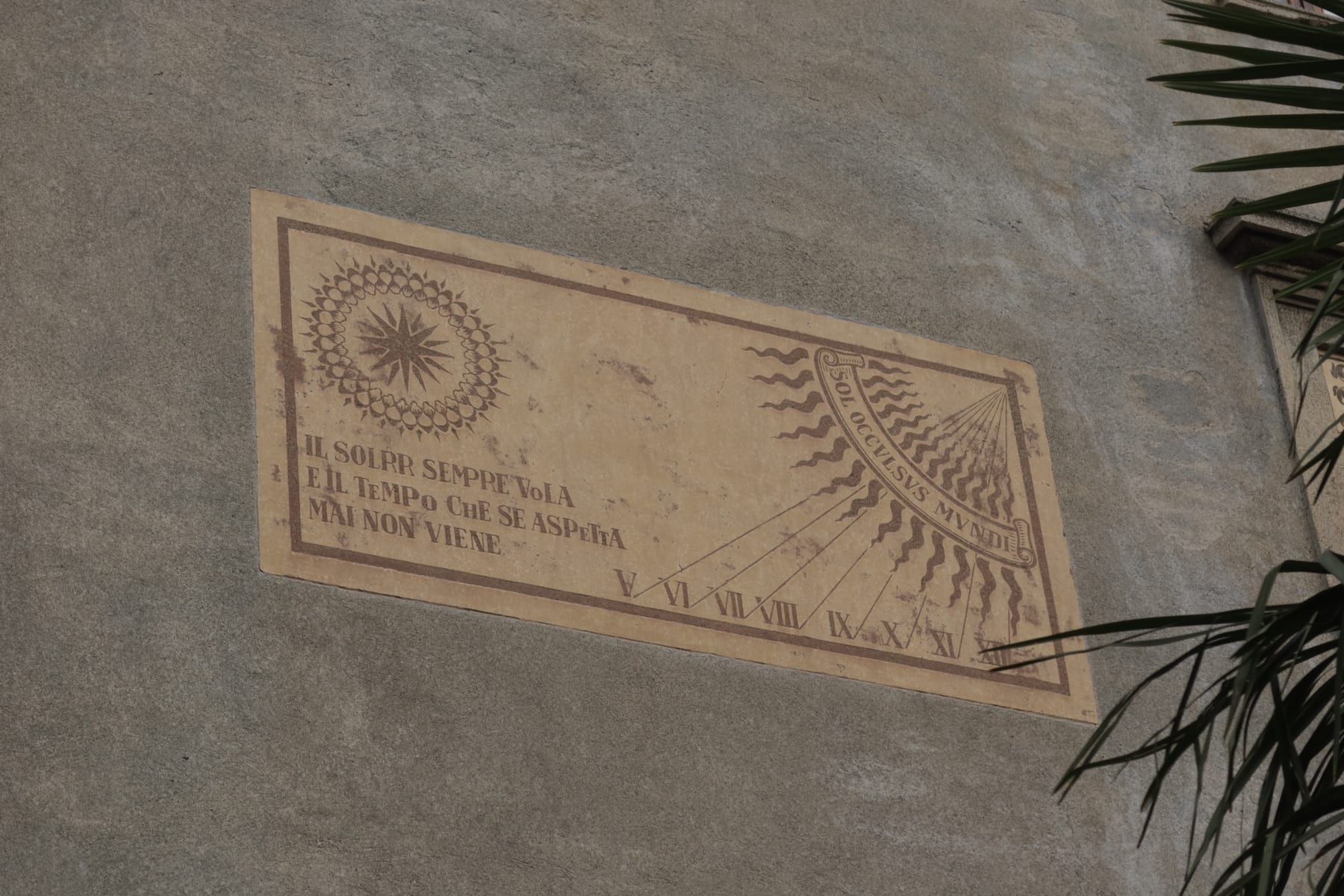
The first thing you need is the wall declination — the angle between the wall's outward-facing direction and due south (in the Northern Hemisphere) or due north (in the Southern Hemisphere).
A wall facing exactly south has a declination of 0°. A wall facing south-west has a positive declination; south-east, negative. In practice, almost no wall faces exactly south — buildings follow streets, property lines, and terrain, not the sun. A typical wall might face anywhere from south-east to south-west, and the geometry handles the full range.
How to measure it: Hold a compass flat against the wall and read the bearing of the outward-facing direction. A phone compass works for a first estimate. For higher accuracy, mark a shadow at a known time, compute the sun's azimuth for your location at that moment, and derive the wall bearing from the difference. That method — using the sun itself — is accurate to a fraction of a degree.
Step 2: Compute the gnomon geometry
Once you know the wall declination, two numbers define how the gnomon sits on the wall.
Style height (SH)
The angle between the gnomon's shadow-casting edge and the wall surface. Think of it as how far the gnomon sticks out from the wall.
On a due-south wall at 45°N latitude, the style height is 45° — a substantial projection. But as the wall rotates away from south, the style height shrinks. At a south-west orientation (azimuth 225°), it drops to about 30°. Near due east (azimuth 97°), it's barely 5° — the gnomon lies almost flat against the wall, and the sundial becomes marginal.
Substyle distance (SD)
The rotation of the gnomon's base from the vertical centre line of the dial face. On a south-facing wall, the substyle is 0° — the gnomon sits right on the vertical noon line. As the wall rotates away from south, the substyle shifts sideways. A south-west wall at 225° and 45°N has a substyle around 37° — the gnomon base is well off-centre.
These two values — style height and substyle distance — completely define the gnomon's position on the wall. Everything else follows from them.
Try it yourself
The explorer below lets you see how style height and substyle distance respond to changes in latitude and wall orientation. Move the sliders and watch the numbers update in real time.
Notice what happens as the wall orientation approaches due east (90°) or due west (270°): the style height drops toward zero. When it gets below about 2°, the gnomon would lie so flat against the wall that the shadow becomes too diffuse to read. That's the degenerate case — the calculator flags it and tells you a vertical sundial won't work at that orientation.
Step 3: Draw the hour lines
With the gnomon placed, the next step is the hour lines — the lines on the dial face that the shadow crosses as the sun moves through the sky.
Each hour line corresponds to a solar hour angle: 0° at solar noon, +15° per hour in the afternoon, −15° per hour in the morning. The angle of each line on the wall is computed from the style height, the substyle distance, and a third quantity called the difference of longitude — the solar hour angle at which the sun lies in the plane of the gnomon.
The formula uses an atan2 formulation that keeps the hour lines monotonic (evenly ordered) across all wall orientations. This matters: simpler formulas can produce hour lines that wrap around or cross each other on walls with large declinations — a bug that looks subtle in code but produces an obviously broken dial on a wall.
What the lines look like
On a due-south wall, the hour lines fan out roughly symmetrically around the vertical noon line. Morning and afternoon are mirror images.
On a declined wall, the symmetry breaks. A wall facing 207° (south-south-west) at a mid-latitude has its morning hours compressed into a tight fan while the afternoon hours spread wide. A south-east wall shows the opposite pattern. This asymmetry isn't a flaw — it's a faithful geometric reflection of how the sun actually moves across that specific wall.
Step 4: Determine the operating hours
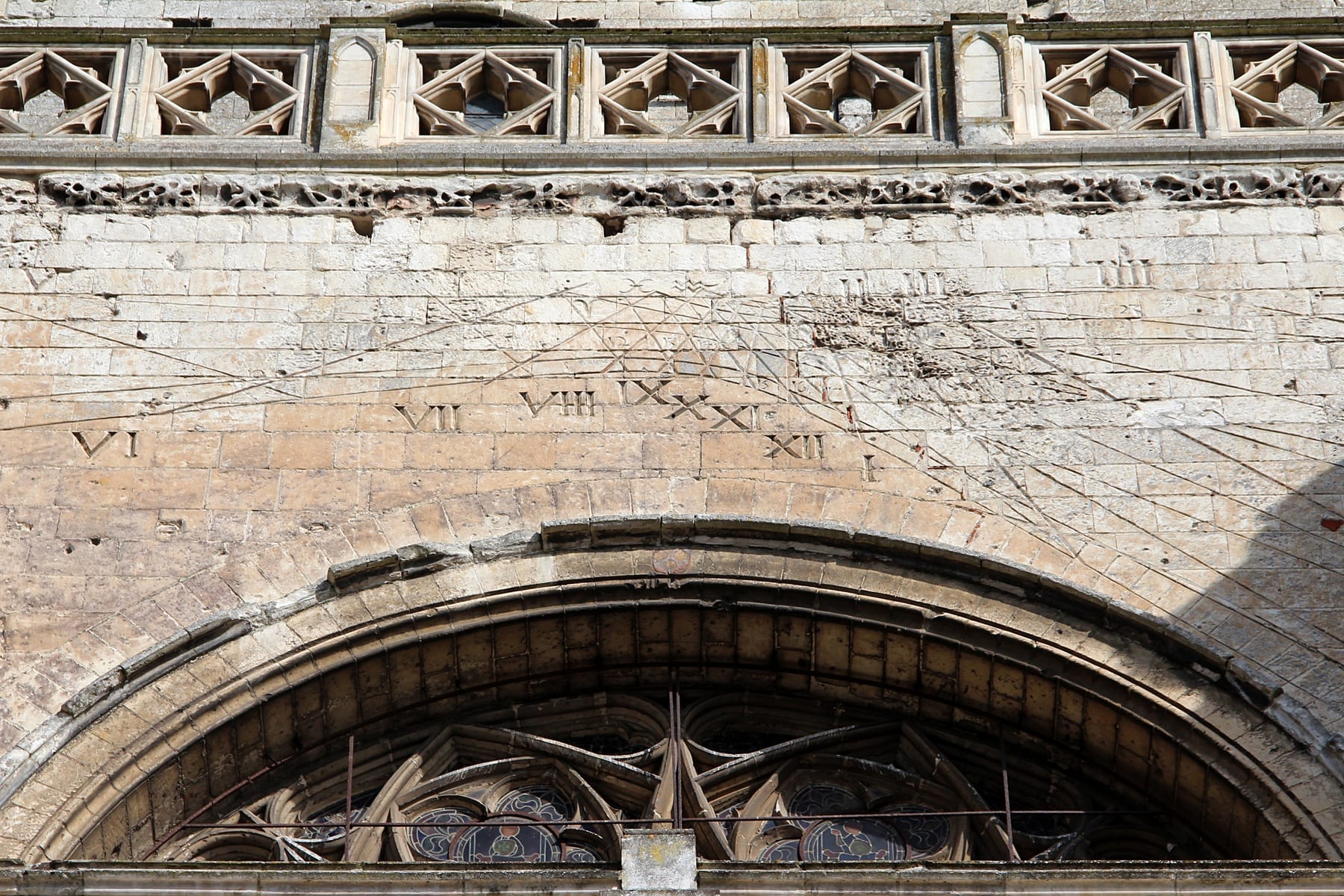
Not every hour line belongs on every dial. A wall only receives direct sunlight during part of the day — when the sun is above the horizon and on the wall's side of the building.
A south-east wall might catch sun from about 6 AM to 3 PM in summer, but only from 8 AM to 2 PM in winter. A south-west wall catches the afternoon instead. Only the illuminated hours get lines on the dial.
The calculator computes operating hours at three reference dates — the summer solstice, the equinox, and the winter solstice — to map the full seasonal range. Hour lines are drawn only within the widest usable window, keeping the dial clean and readable.
Top-down view. Each coloured arc is the sun’s azimuth path across a single day at that season. Only the brighter segments fall within 90° of the wall’s outward normal — those are the hours the wall is lit. A south-south-west wall catches most of the afternoon and some morning; the mornings shrink further in winter.
Step 5: Apply the longitude correction
There's one final adjustment. Solar noon — the moment the sun reaches its highest point — doesn't occur at 12:00 on your clock unless you happen to live exactly on the central meridian of your time zone.
If you're east of that meridian, solar noon comes early. If you're west, it comes late. The offset can be significant — up to 30 minutes in large time zones.
The calculator shifts all hour labels by this offset, so the lines on the dial correspond to clock time, not raw solar time. Someone checking their phone against the sundial should see agreement — within the few minutes of the Equation of Time, which varies by season.
Each 1° of longitude away from the time zone’s central meridian shifts solar noon by four minutes. Varna sits 2.09° west of the standard meridian for UTC+2, so the sun reaches its highest point 8.36 minutes after the clock reads 12:00. The calculator applies this correction automatically, so hour labels on the dial match what you read on your watch.
Putting it together
A vertical sundial is fully defined by five inputs: latitude, wall bearing, longitude, time zone, and dial size. From these, the calculator produces everything you need: the gnomon angle and position, the angle of every hour line, and the seasonal range of operating hours.
The NORTIA SUNDIALS calculator does all of this in real time. Set your location and wall orientation, and the complete dial face updates live — hour lines, gnomon, substyle, the lot.
Previously: What Is a Sundial? — the broader context, types of sundials, and how solar time differs from clock time.