A History of Sundials
From an L-shaped slab in the Egyptian Museum of Berlin to the painted facade dials of Renaissance Europe — three thousand years of telling time by shadow.
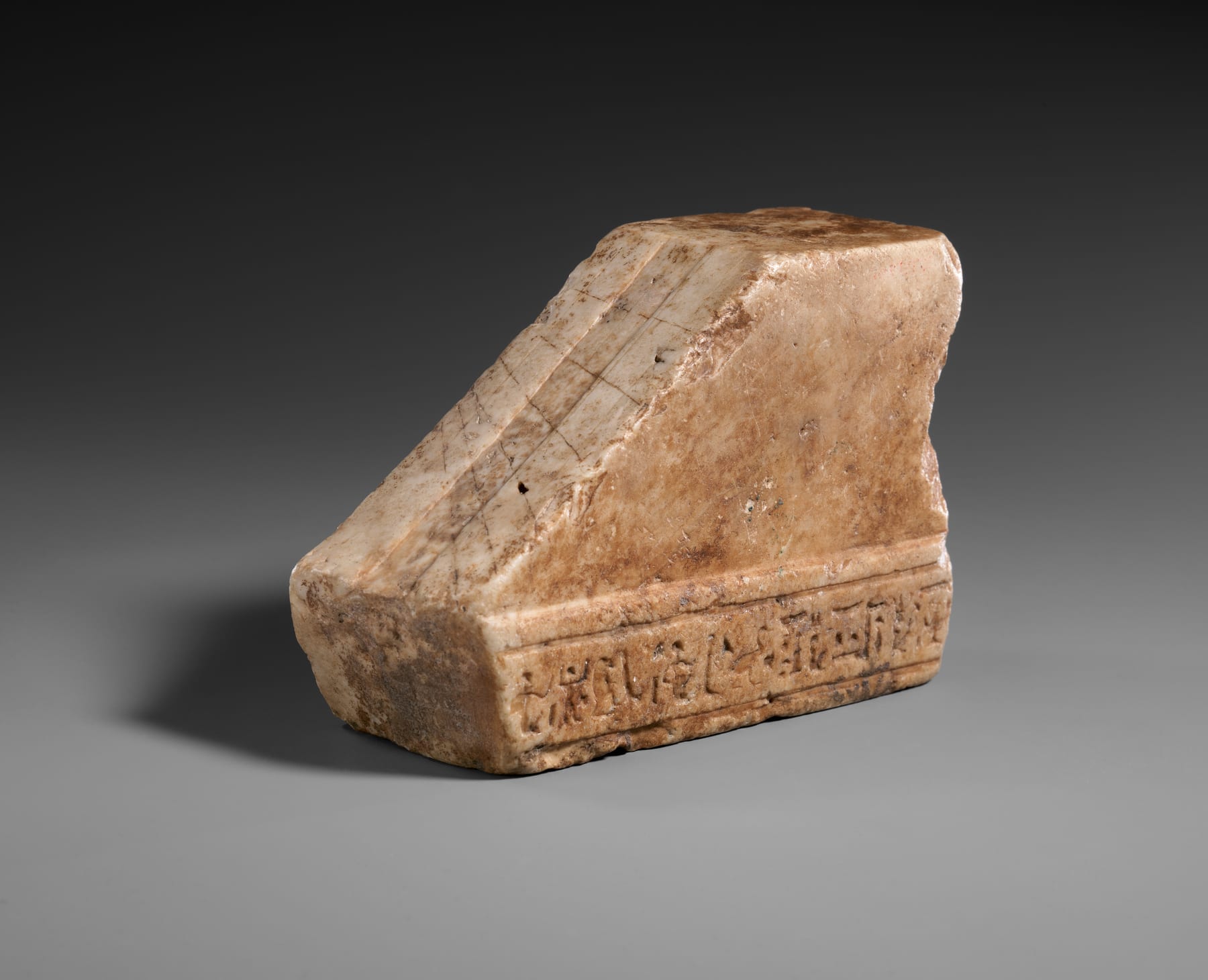
In the Egyptian Museum of Berlin there is a small green slate object, L-shaped, about fifteen centimetres across, engraved with the cartouche of Thutmose III — the pharaoh who died in 1425 BCE. It is a shadow clock. A horizontal bar marked with five ticks; a vertical fin that casts the shadow; a hole where a plumb bob keeps the whole thing level. It is the oldest portable timepiece in the world that has survived.
The story of sundials is the story of people working out, over three thousand years, exactly how a shadow can be made to tell useful time — and building instruments, in stone and marble and brass, that encoded the answer.
Egypt: obelisks, shadows, and the twelve-hour day
Egypt gave the world the basic division of daylight into twelve hours, and with it the first instruments accurate enough to mark the division in practice. The division itself is older than any surviving sundial; by the time of the Middle Kingdom, around 2000 BCE, Egyptian priests were already scheduling temple rituals by a twelve-part day (and, symmetrically, a twelve-part night).
Obelisks did most of the early work. A tall standing stone casts a long shadow, and the tip of that shadow sweeps a curve across the ground as the sun arcs across the sky. The Egyptians learned that the tip's position at solar noon changed through the year, tracing out what would later be called a seasonal curve. The obelisks at Karnak, Luxor, and Heliopolis were calendars as much as monuments.
The portable shadow clocks — the L-shaped type in Berlin, and similar pieces now in the Metropolitan Museum, the Rijksmuseum van Oudheden in Leiden, and the Egyptian Museum in Cairo — are the first true sundials: compact, graduated, and intended to be read. They worked on equinox days and only approximately at other times of year, because their geometry does not account for the sun's changing declination. That correction would wait another two millennia.
Greece and Rome: the gnomon arrives
According to Herodotus (Histories 2.109), the Greeks learned of the gnomon from the Babylonians. The philosopher Anaximander of Miletus — the same man who drew the first Greek map of the world — is said to have installed a gnomon at Sparta in the 6th century BCE, where it was used both to tell time and to mark solstices and equinoxes. No physical gnomon of Anaximander's survives, but the practice spread.
Greek astronomers refined the design. The spherical hemicyclium, described in the 3rd century BCE, hollowed a bowl out of a stone block so that the tip of a small gnomon cast its shadow onto an interior surface graduated in hours. Because the bowl approximated a portion of the celestial sphere, the hour lines were simpler and the instrument worked across the seasons.
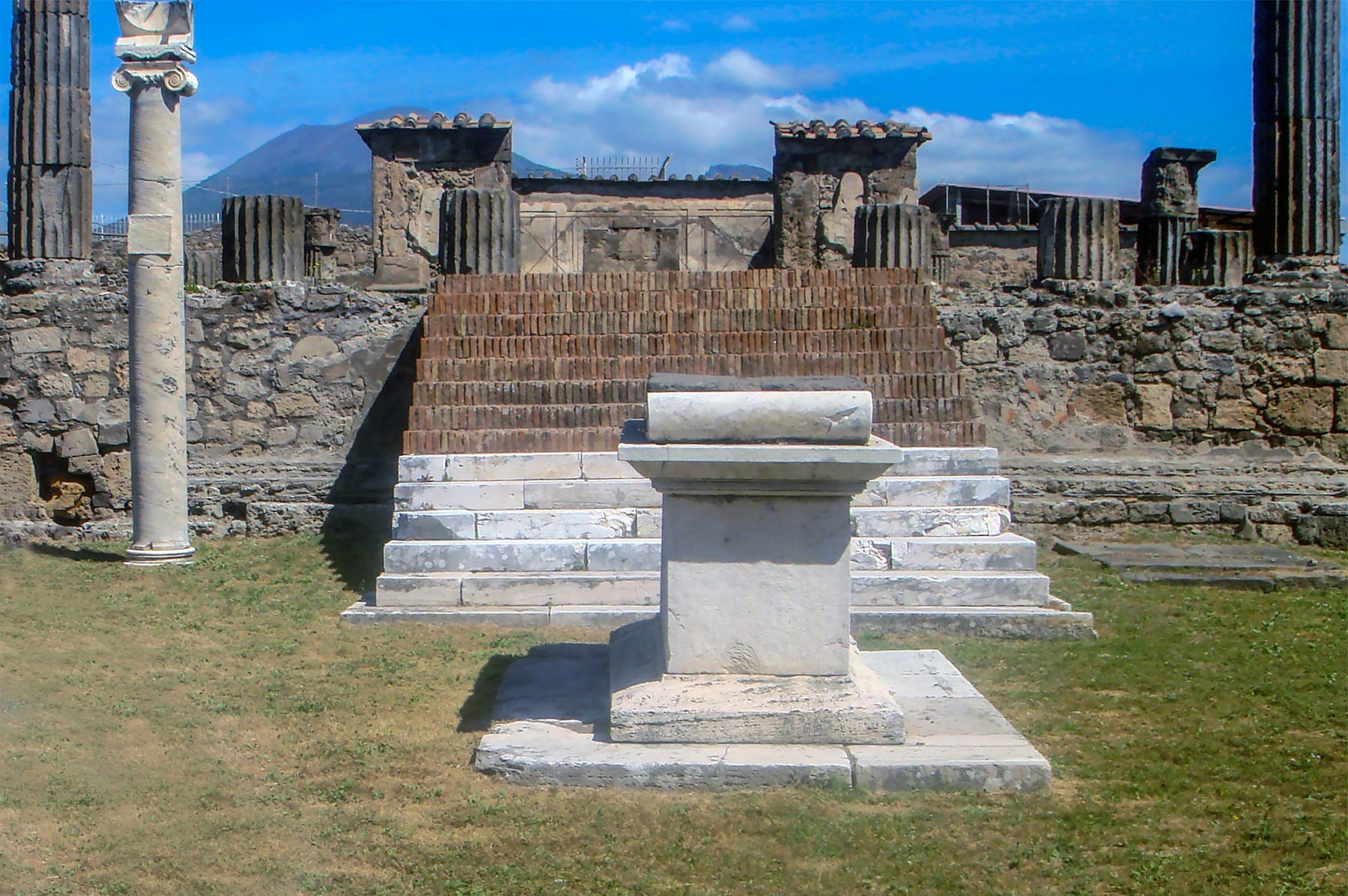
By the 1st century BCE the Romans had adopted and mass-produced the form. The best-preserved ancient example is the Tower of the Winds in Athens, built around 50 BCE by Andronikos of Kyrrhestes — an octagonal marble tower whose eight faces each carry a vertical sundial, with personifications of the winds carved in relief above them. Cicero's correspondence is peppered with references to sundials. When Pompeii was destroyed by the eruption of Vesuvius in 79 CE, the sundial donated to the Temple of Apollo by the local magistrates was buried with the city; it was dug out intact, columns and all, in the nineteenth century.
Roman sundials were the first true consumer instruments. A traveller buying a sundial in Rome for use in Hispania would find the hours wrong, because the design was specific to the latitude it was cut for — a frustration remarked on by the satirist Vitruvius. This problem would become the central preoccupation of Islamic gnomonics, five hundred years later.

The Islamic Golden Age: mathematics catches up with the instrument
From the 8th to the 14th centuries, scholars in Baghdad, Damascus, Cairo, Toledo, and Samarkand transformed sundial design from a practical craft into a branch of mathematics. Three factors drove the advance. First, the Arabic translation of Greek astronomical texts — particularly Ptolemy's Almagest — gave access to the surviving Hellenistic tradition. Second, a new trigonometry, with the sine function replacing the Greek chord, made the geometry tractable. Third, the religious requirement to establish prayer times and the direction of Mecca (qibla) made accurate sundials matter in every mosque.
Al-Battani (c. 858–929), working at al-Raqqa on the Euphrates, compiled tables of trigonometric functions that remained in use for six hundred years. The astronomer Abu Mahmud al-Khujandi, working at Rayy in the 10th century, built a mural quadrant large enough to measure the obliquity of the ecliptic to within minutes of arc — better than any Greek measurement. The 11th-century polymath al-Biruni wrote a treatise on shadow-geometry that worked through sundial design for every latitude and every wall orientation, with the mathematics that now sits inside every sundial calculator — including the one on this site.
The masterpiece of the tradition is a 2-metre marble slab, engraved in 1371 by Ibn al-Shatir and installed on the minaret of the Umayyad Mosque in Damascus, where he served as muwaqqit (timekeeper). It is the oldest surviving polar-axis sundial. Earlier sundials had their gnomons vertical to the dial face; Ibn al-Shatir angled his parallel to the Earth's axis of rotation, which makes the hour lines evenly spaced and the shadow sweep at a constant fifteen degrees per hour — the form used by nearly every sundial built since. The original fragments are preserved in the Damascus National Museum; the sundial now on the minaret is an exact 19th-century copy.
The Renaissance: sundials on every facade
The fall of Constantinople in 1453 and the invention of printing two decades later brought Islamic astronomical knowledge rapidly into Western Europe. The first printed ephemerides — Regiomontanus's tables, 1474 — carried Ibn al-Shatir's hour-line mathematics into every astronomer's library.
What followed was a European obsession. The years 1500 to 1650 were the great age of the sundial. Every cathedral got one. Every noble house got one. Wealthy amateurs collected them. Books on gnomonics — the branch of mathematics devoted to sundial design — proliferated. Peter Apian's Cosmographia (Antwerp, 1524) explained the geometry with moving paper volvelles readers could turn. The Jesuit mathematician Christoph Clavius, the same man who reformed the calendar for Pope Gregory XIII in 1582, published his Gnomonices Libri Octo in Rome in 1581 — a thousand-page treatise that remained the standard reference into the eighteenth century.
The instruments themselves took every form the mathematics allowed. Horizontal dials on garden pedestals. Equatorial dials on walls. Vertical declining dials on the painted facades of every Italian church and every German town hall. Polyhedral dials whose six or twelve faces each read the same time by different geometries. The sundials of Queens' College Cambridge (1642), Chartres Cathedral (1528), and the Palazzo Vecchio in Florence all date from this century or the one following.
The 16th-century Piedmontese painter Giovanni Francesco Zarbula built roughly a hundred vertical declining sundials across the French and Italian Alps; about fifty survive, each one a fresco set into the wall plaster, with baroque or geometric or bird-themed ornament framing the hour lines. A dial in Borgosesia, a dial on the cathedral at Saint-Omer, a dial on a mountain church near Briançon — the craft spread wherever walls faced the sun.
After the pendulum
In 1656 the Dutch astronomer Christiaan Huygens built the first pendulum clock. Within a generation, mechanical clocks were keeping time to within seconds per day, and the sundial's role as the world's timekeeper was over.
What followed was not extinction but specialisation. Sundials continued to be built — often as ornaments, sometimes as practical instruments — but the mathematics kept advancing. The English astronomer John Flamsteed, first Astronomer Royal, formalised the Equation of Time in the 1670s, giving sundial users a correction table to reconcile solar time with the new, uniformly-ticking mechanical hour. The French École royale produced sundials accurate enough that navigators used them to calibrate ships' chronometers.
By the 19th century the sundial was, for most people, a garden ornament — but the instrument had also acquired a new role as a pedagogical object. Sundials appear in public parks, botanical gardens, and school grounds, usually horizontal, usually bearing a motto about the fleetingness of time.
Now
The revival of interest in sundials is recent and genuine. Architects specify them for new public spaces. Private owners commission them for walls that would otherwise carry nothing at all. The British Sundial Society (founded 1989) and the North American Sundial Society (founded 1995) publish research, track installations, and maintain registers of historical dials. The mathematics that al-Biruni worked out in the 11th century and Ibn al-Shatir engraved on marble in the 14th is the same mathematics that runs in the calculator on this site — rewritten in JavaScript, but unchanged in any essential.
A well-built sundial will keep time, accurate to within a minute or two after the Equation of Time is applied, for as long as the wall stands. That is the appeal. Three thousand years of accumulated mathematics, cut into a surface that will outlive every battery ever manufactured.
Further reading on this site: What Is a Sundial? · How Vertical Sundials Work