Reading a Sundial
Why a sundial reads different from your phone — longitude, the Equation of Time, and how the two corrections combine to convert sundial time into wall-clock time.
If your sundial reads 11:38 when your phone shows 12:00, neither one is broken. They are measuring two different things — and the gap between them is made out of two specific, knowable pieces of physics.
A mechanical clock ticks in exactly equal seconds. A sundial reports what the sun is actually doing overhead, and the sun is not quite punctual. The length of a solar day — the time between two successive passages of the sun across your meridian — varies by tens of seconds through the year. Those seconds accumulate. By early November the sun is running more than 16 minutes ahead of a perfectly uniform imaginary sun; by mid-February it lags nearly 14 minutes behind.
On top of that, your phone was never pegged to your own meridian in the first place. It was pegged to a time zone — a band of longitude 15° wide where everyone agrees to share one standard time. If you live at the edge of that band, solar noon and clock noon can be half an hour apart before the sun's own irregularities enter the calculation.
The two effects combine into a single correction between sundial time and clock time. Historically, a sundial-maker wrote the correction on a card that stayed with the dial; some went further and engraved the correction directly on the dial face. Either way, the physics is the same.
The first correction: longitude
Time zones are a 19th-century convenience. Before standard time, every town kept its own noon — the moment the sun crossed the town's meridian. Synchronising railway schedules across dozens of such town-clocks was a nightmare, and by the 1880s most of the industrial world had switched to wide zones of shared time. The sun, however, pays no attention.
Each hour of time zone covers 15° of longitude (360° / 24 h). If you sit exactly on your zone's central meridian, solar noon occurs at 12:00 on your clock — ignoring the second correction for the moment. If you sit one degree east of that meridian, the sun reached your meridian four minutes before clock noon; one degree west, and it arrives four minutes after. The rule is simple: one degree of longitude = four minutes of time.
Vienna, for example, sits at 16.37°E. Central European Time (UTC+1) has its central meridian at 15°E, so Vienna is 1.37° east of standard — about five and a half minutes ahead of clock noon. At Vienna's mean solar noon, a wristwatch on CET reads 11:54:30. That part of the correction never changes; it is fixed by the dial's longitude.
The same derivation, worked through for Varna on the Bulgarian coast with an interactive clock-bar diagram, lives in How Vertical Sundials Work — Step 5.
The second correction: the Equation of Time
The other correction is harder to see coming, because it depends on the date. It is called the Equation of Time, from the Latin aequatio — the word meaning "that which makes equal." A 17th-century astronomer would have understood the name literally: the amount you have to apply to make the real sun match the idealised one.
Two things conspire to make the sun's apparent motion non-uniform.
First, the Earth's orbit is elliptical, not circular. At perihelion, in early January, the Earth is closest to the sun and moving fastest; at aphelion, in early July, it is farthest and slowest. Kepler's second law does the bookkeeping: the line connecting Earth and sun sweeps equal areas in equal times, which means the angular speed varies. Seen from the ground, the sun races ahead against the background stars during fast-orbit months and lags during slow-orbit ones.
Second, the Earth's axis is tilted by 23.4° relative to the plane of its orbit. Even a sun moving at perfectly uniform angular speed along the ecliptic — the path of the orbit projected onto the sky — would not move uniformly along the celestial equator, which is the axis a clock actually cares about. The tilt projects the ecliptic onto the equator with a little trigonometric distortion that peaks four times a year.
Each effect traces a sine wave through the year. Stacked on top of each other, they produce the figure-eight shape known as the analemma.
The analemma, photographed
A camera pointed at the same patch of sky, shutter opened once a week at the same clock time for a full year, records the analemma as a figure-eight of sun-images. The first such composite was made in 1978–79 by the American astrophotographer Dennis di Cicco, working from a rooftop in Watertown, Massachusetts. His method has since been repeated by dozens of amateur astronomers.
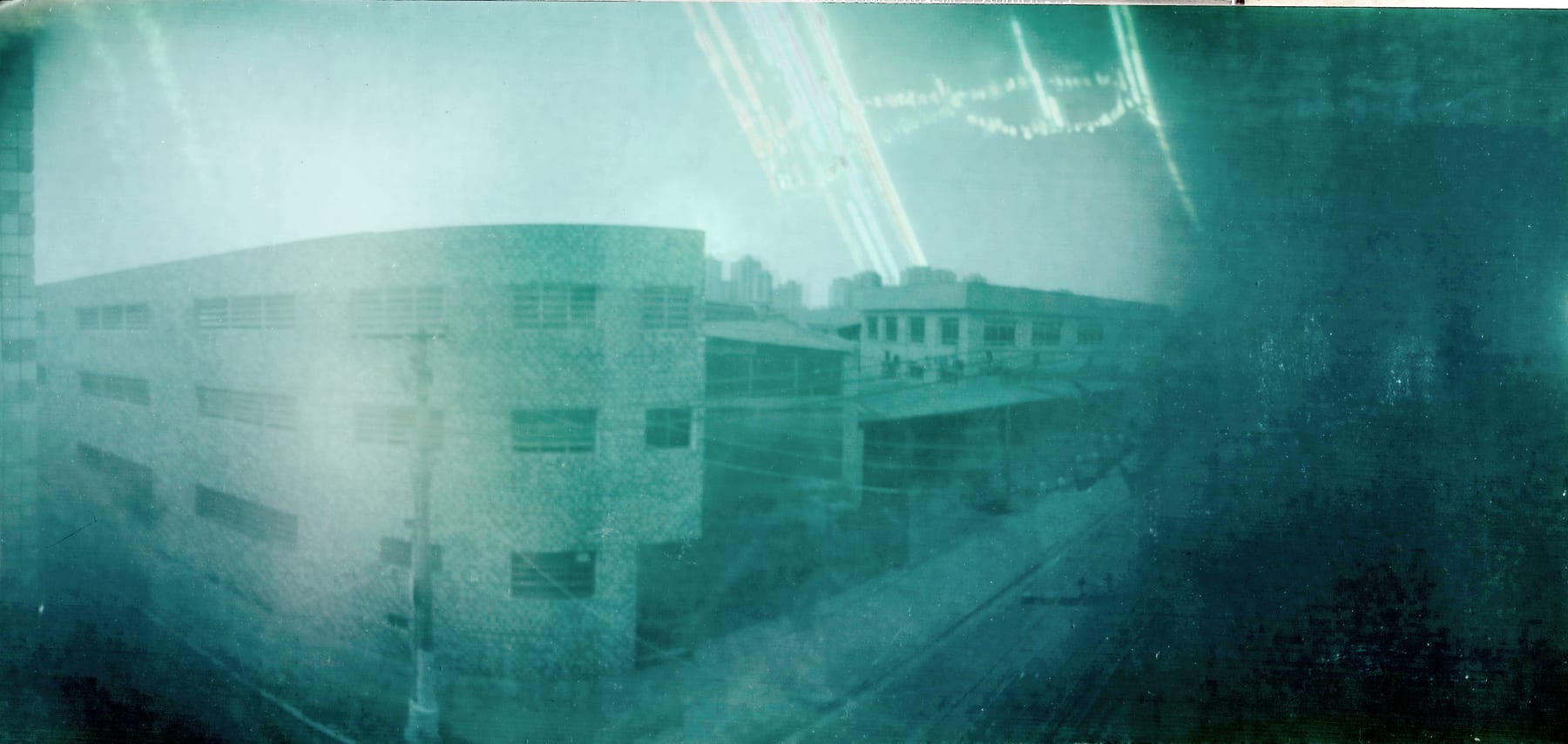
The taller lobe corresponds to the winter half of the year in the Northern Hemisphere — when axial tilt and orbital eccentricity happen to pull the sun in the same direction. The shorter lobe is the summer half, when the two effects partly cancel.
The analemma, as a graph
Plotting the same information against day of year makes the structure easier to read: the x-axis is the date, the y-axis is the offset in minutes between sundial time and mean solar time. Zero means the two agree; positive means the sundial runs ahead of the clock; negative means it runs behind.
A few things worth noticing.
The peaks are asymmetric. The curve reaches about +16 minutes in early November but only about +4 minutes in May. The troughs are similarly uneven. If the correction came from axial tilt alone, the pattern would be symmetric; the eccentricity wave is what biases it.
Four zero-crossings a year. The sundial agrees with the clock on exactly four days: around 15 April, 13 June, 1 September, and 25 December. Christmas Day is one of them — a small coincidence the calendar did not design for.
Toggle the component waves on. The taller dashed curve is the obliquity contribution (axial tilt, oscillating twice a year, ±9.9 min). The shorter dashed curve is the eccentricity contribution (elliptical orbit, oscillating once a year, ±7.7 min). Added together, they give the solid gold curve.
Who figured this out
Ancient astronomers already knew the sun's motion wasn't uniform. Ptolemy, writing in Alexandria around 150 CE, devoted a chapter of his Almagest to tabulating the correction — originally needed for planetary position calculations, where the error accumulates quickly. Mechanical clocks did not yet exist; no one needed the correction for timekeeping.
Islamic astronomers refined the measurements. Al-Biruni, working at Ghazni in the early 11th century, computed the obliquity of the ecliptic to within arcminutes of the modern value and produced solar tables accurate enough for practical use. By the time Persian and Arab astronomy reached medieval Europe through translation, the Equation of Time was a well-known astronomical quantity.
The modern version — a compact formula, backed by systematic observation and intended for practical time-conversion — is the work of John Flamsteed, the first Astronomer Royal. Appointed by Charles II in 1675, Flamsteed worked from the new observatory at Greenwich for more than forty years. His successive tables, published in Tabulae Britannicae and eventually in the posthumous Historia Coelestis Britannica (1725), gave sundial-makers a definitive reference they could engrave into the dial face or print alongside the instrument.

A note on the word. Equation here is older than its modern algebraic meaning; it shares a root with equalise. A 17th-century reader saw it as "the correction that makes things even."
Worked example: Vienna, 3 November 2026
Put the two corrections together. A sundial on a Viennese wall reads exactly 12:00 on 3 November 2026 — the shadow sits on the noon line. What does a wristwatch on CET (standard time, no daylight saving) show?
- Equation of Time on 3 November (day 307): approximately +16.4 minutes. The sun is running 16.4 minutes ahead of the idealised uniform sun.
- Longitude correction for Vienna: 16.37°E − 15°E = 1.37°, or +5.5 minutes. Vienna is east of its standard meridian, so mean solar noon arrives 5.5 minutes before clock noon.
- Daylight saving: not in effect in early November.
The sundial shows apparent solar time — the real sun, with all its quirks. To get clock time, subtract the Equation of Time (to get from apparent solar to mean solar), then subtract the longitude offset (to get from mean solar at your location to standard zone time).
12:00 − 16.4 − 5.5 = 11:38:06 on your wristwatch.
Six months earlier, on 15 May, the same Vienna sundial reading of 12:00 would correspond to about 11:50 — same longitude correction, but only +3.6 minutes of EoT. Five weeks later, on 10 February, it would correspond to 12:09 — the EoT flips sign in winter. The sundial is deterministic; a wristwatch against the sundial is a moving target.
How a working sundial actually applies the correction
Three ways, in order of sophistication.
A separate correction table. The simplest approach. Every serious sundial-maker from the 17th century onward published a card or small plaque listing the correction by date. Look up today, apply the correction, done. Most historical instruments came with one.
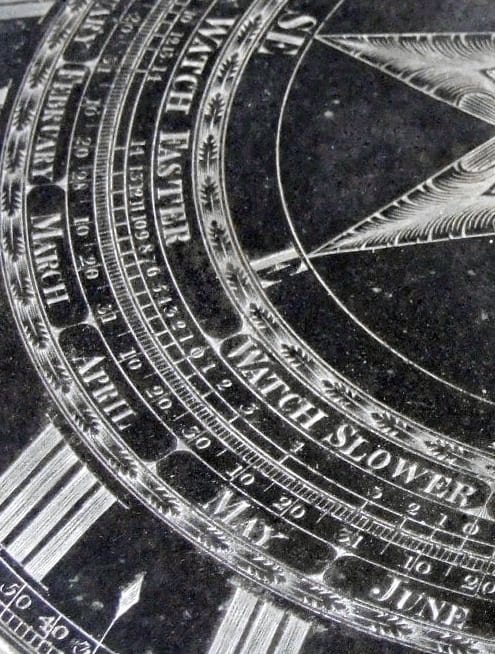
A table engraved on the dial itself. More elegant, and durable. An 1812 sundial in Derby, made by Whitehurst & Son of Derby, carries the Equation of Time correction engraved directly onto its face — a circular scale around the hour markings, giving the offset in minutes for each week of the year.
An analemma engraved as the hour lines themselves. The most ambitious option. Some sundials — most often Italian and French examples from the 18th and 19th centuries — carry figure-eight hour lines on the dial face, so that the shadow's tip lands on the correct clock-time gradation directly, with no mental arithmetic. The hour line for, say, 9:00 AM is itself an analemma, sweeping through the dial according to the season. These are mathematically beautiful and difficult to lay out; a whole subspecialty of sundial design is devoted to them.
For a digital calculator, there is a fourth route: compute the correction on the fly. Apply the EoT for today's date, add the longitude offset, apply any DST, and report the wall-clock equivalent. The calculator on this site does exactly this — so the displayed operating hours are the hours you would actually see on a wristwatch standing in front of the dial.
Further reading: Sun Mechanics — the astronomy of the tilt and the orbit that produce the EoT · How Vertical Sundials Work — full derivation of longitude correction with an interactive diagram · What Is a Sundial?